

Santa arriving at a “well-connected rail station”.
Chestnuts roasting. Children laughing. Jack Frost nipping at your nose. It’s beginning to look a lot like… awards season.
So, come on down. Shoes: polished. Bling: sparkly. Bow-ties: optional. But don’t be late. Bring your A-game, and meet me on that reddest of red carpets for an iconic evening in our planning calendar. The great. The good. They’re all there. [Cue the band]
Welcome, friends, to the 6th (😬!) annual… 🏆 #planorak awards 🏆.
[Hold for applause].
Thank you. Thank you so much. Please, take your seats.
Well, what a year it’s been. So many runners and riders for the big gongs, the envelopes were almost sealed, and then… just this week… a December surprise. Well, not a surprise exactly, in that it seems to be happening every December. And happen it has. Here here we have it, folks, hot off those Marhsam Street presses: a new draft National Planning Policy Framework. Yes, Brenda, I know what you’re thinking:
But here we have it. Another one. And one produced just in time for awards season. Convenient.
As you can imagine, the judges have been reeling with all the last-minute drama. So before we get to handing out the trophies, can I try to help them, and maybe some of you, with a just few things you really do need to know about this planning policy event of the year: the consultation draft of the new NPPF. And then, of course, the awards.
First, the basics:
The new draft NPPF: here.
The accompanying consultation doc: here.
Deadline for responses: 11.45pm on 10th March 2026. You can respond: here. Shouldn’t take long. There’s only 225 questions to think about.
The press release: here.
The written ministerial statement: here.
The letter to local authority leaders: here.
Tweaked viability PPG: here.
A health warning - both for what’s coming below, and for the many linkedin posts and webinars some of you will be ploughing into this week. This new NPPF’s 125 pages and the consultation doc’s another 123. It’s long, dense and complicated. It’s been live for under 24 hours. And, let’s be real: it’s been a long year, we’re all perhaps just a little tired. This is BIG stuff that will take weeks - heck, months - to percolate.
Nonetheless, you want a flavour? Well, here’s a flavour. Delivered through the medium of 10 quick-hit headlines:
The biggest change to national planning policy since 2012 (easily)
First rule: don’t listen to any naff “quick-hit” headline write-ups [Ed. Hang on…🤔].
The 2012 NPPF was a seismic change - for some of the reasons I talked about here. Evaluating its implications took years.
We’ve had 6 new versions since then. Some good. Some reeeeallllly bad.
But this one… this is the first fundamental restructure of national planing policy that we’ve had since 2012. A new start. With a raft of new concepts, new language and new ideas. Designed to support a new system (e.g. led by spatial development strategies and new-style local plans, supported by national decision-making policies, more of which below).
Remember those quaint side-by-side spot-the-difference tracked change comparisons from years gone by? Well… you can forget those now.
Because wherever you look, there are changes. Some big, some small, some cosmetic, some critical. New tilted balances left, right and centre. New weightings for things. TRAINS. 🚂. This will take months to unpick properly. And we have months… well, we have until 10th March 2026. And there is much to think about before then. Before you sharpen your consultation pencils, and start working through those 225 questions next year. Anyhow, for now, let’s dip our toes into it together…
Transitioning
When would it all kick in?
For decision-taking, the new NPPF kicks off on the day it’s published next year. Until then, well… we have the old/current one.
For plan-making, the new NPPF applies to new-style local plans to be produced through the new system under the Planning and Infrastructure soon-to-be-Act.
All other plans - i.e. the many local plans being progressed at the moment under the current system - they will all continue to be examined under the 2024 NPPF.
National Decision-Making Policies (“NDMPs”)
They’re here. Scattered into every chapter of the new NPPF.
Big news: the “DM” doesn’t stand for “development management” any more.
Bigger news, albeit we knew this was coming: they’re “non-statutory” - I’ll come back to that in a minute.
Many are similar to NPPF policies we already have. But there are some huge changes - again, more of which below.
On their effect:
For plan-making: the NPPF does not want plan-makers to “duplicate, substantively restate or modify” what’s in NDMPs: PM6.
For decision-taking: from day 1 of this new NPPF, development plan policies which are in any way inconsistent with the NDMPs get “very limited weight”, except where they have been examined and adopted against the new NPPF.
Is all of that going to work… I come back to that in a sec.
Spatial development strategies a’coming
The Planning and Infrastructure Bill (here), now on the cusp of becoming law, introduces the concept of “spatial development strateges” - new plans which “must include a statement of the strategic planning authority’s policies (however expressed), in relation to the development and use of land in the strategy area, which are of strategic importance to that area”.
The new NPPF puts meat on those legislative bones on, for instance, what goes into SDSs, how they get examined, and how they fit into the wider system.
Now we know that SDSs are a 20+ year vision for a “sustainable pattern of growth”. They set “objectively assessed needs” for things including housing for that period. They identify broad locations for new settlements and major urban extensions. They give spatial expression to Local Growth Plans and the National Industrial Strategy. They identify the general extant of Green Belt boundaries, and broad locations for changes to those boundaries. They set out the staregic infrastructure needs to support all of this growth. They communicate all of that using maps and pictures.
A huge amount to unpack in all of this, including a new “soundness” test for examining SDSs (PM14). But for now, what you need to know is that they’re coming, and this NPPF tells us how. If the Government sticks around long enough to see this change through, SDSs could be the most powerful driver for strategic growth in the planning system in the last quarter of a century. Big stuff.
Local plans a’changing
With the advent of SDSs and NDMPs, the scope of what local plans will have to do is scaled back.
Local plans now only get involved in, for instance, deriving a local housing requirement if there is no SDS in place that’s already done that job: S1. The local plan needs a vision with 10 max (no more!) measurable outcomes to articulate change over a 15+ year period. New-style local plans will, of course, be governed by a new plan-making regime which the government has already been announced here. And, as I’ve said, new local plans can’t duplicate (or - without very good reason - deviate from) the approach to development management in the NDMPs. Plus NB a new approach to “soundness” - they no longer to actually be effective, there just has to be a reasonable prospect that they can be delivered.
What local plans become, then, is a vehicle for giving detailed and localised spatial expression to a strategy that’s already been worked out in the SDS. Not a battle-ground for arguing about housing numbers. Or the need for infrastructure. Nor indeed for arguing about detailed development management policy. A detailed map. Basically. An easily searchable list of allocations and designations. Doable in 30 months. Reviewable at most every 5 years, and maybe less.
Sounds good? We should all hope so in a world where 72% of local plans are over 5 years old, 67% of authorities do not have a 5 year housing land supply, and around 100 authorities will soon be failing the housing delivery test. We don’t currently live in the plan-led world the system envisages - more on that below.
A note of concern? In reality, the whole 30-month structure assumes the development needs for local plans have been fixed by an SDS. Which is fine. If they have been. If they haven’t been e.g. because the SDS isn’t adopted yet, then local plans will still have much of the time-consuming and contentious work to do that they have now. And that work is currently taking them, on average, not 30 months, but 7 years per plan. So, I suppose the answer to that concern = the sooner SDSs actually come forward, the better.
New presumptions, new balances, new tilts
How, in the meantime, are applications to be determined?
Since 2012, we’ve gotten used to the so-called “tilted” balance - topic of Supreme Court litigation, (literally) thousands of planning appeals and even the odd blog post here and there. Well. That’s gone.
Remember all those arguments about whether policies are “out of date”. “Baskets” of all of those “most important” policies. That stuff? Gone. The concept of “out-of-datedness” itself (which I went into a bit here), that’s gone.
It’s an almost entirely basket-free NPPF.
So what do we have instead? Well, it depends where you are:
Within settlements (S4):
The consultation calls this a “permanent presumption” focussed on brownfield, urban land. It’s is a powerful, pretty dramatic step forward from the idea at §125(c) of the current NPPF. What’s happening here? Well…
Any scheme within any settlement get’s approved.
Unless its benefits are substantially outweighed by adversed effects. And given the substantial weight lots of those benefits may be getting - more of which below - this sets a really punchy bar for refusing e.g. brownfield schemes within settlements of any kind.
It’s a default yes for planning applications within settlements subject to carve outs (including, critically, if e.g. there’s an NDMP which tells you to refuse planning permission). But still.
A big step. A bold step. So long as you’re sure whether you’re actually within a settlement or not (which may not always be as obvious a question as it sounds - particularly for places without fixed settlement boundaries).
Outside settlements (S5):
Again, a fundamental change in approach. The detailed unpicking of which is going to need some time and some care. But here’s the intro:
The structure of S5 requires granting of permission outside settlement unless benefits would be substantially outweighed by adverse effects if your scheme falls into a list of particular categories. A bolstered “tilt” to the tilted balance. Equivalent to what the ministers keep calling a “default yes”.
The flip-side: if you’re outside those particular categories, you get refused permission absent exceptional circumstances where your benefits substantially outweigh your adverse effects.
So we need to know whether schemes outside settlements fall into these categories or not. What are the categories? Have a look at S5. Big ones include:
Redevelopment of PDL.
Reusing existing buildings.
Development a reasonable walking distance from well-connected rail stations - more on this in a sec. Because this is a biggie.
In circumstances where you’re meeting an “evidenced unmet need” (including, for housing schemes, cases where there is no 5 year housing land supply) and the scheme is:
“well related to an existing settlement (unless the nature of the development would make this inappropriate) and be of a scale which can be accommodated taking into account the existing or proposed availability of infrastructure”.
If you fall into one of these S5 categories, then the “tilt” in favour of permission is (to these tired eyes) stronger than the current tilt at §11(d)(ii).
The concept of “strong reasons” to refuse permission is ditched - thank goodness (although NB we still have “strong” reasons to restrict overall scales of development in SDSs: S1). Instead, for decision-making, we’re told that the new tilted balance is likely to be failed if “the development proposal would fail to comply with one of the national decision-making policies which state that development proposals should be refused in specific circumstances”.
So. Tread carefully now. Because there are a loads of policies in the framework that push one way or pull another. But there are very few that actually prescribe refusal in specific circumstances.
Dense, denser, densest
Part of the disaster of Gove-ian NPPFs was their vision of new developments aping the style of what we already have.
None of that. Now we’re specifically directed to increase densities, to respond to what’s already there (e.g. through materials and integrating heritage assets) but not in a way that precludes appropriate “innovation and change”, and if you’re near a train station, minimum densities are set. Fall short? You get refused.
In particular, for schemes within reasonable walking distance of a railway station - any railway station - “a density of at least 40 dwellings per hectare should be achieved within the net developable area of the site”, and that goes up to “50 dwellings per hectare” where the station or stop is defined as “well-connected”. Again, we’ll come back to what that means in a moment.
Viability
Hundreds of thousands of homes have consent, but aren’t being delivered because of (among other things) viability challenges. Trying to find a route forward for those stalled consents is something the current consultations in London are seeking views on. Now p.29 of this consultation document asks you to comment about a really important topic: using section 73 and section 106A of the Town and Country Planning Act 1990 to modify planning obligations in relation to (in particular) affordable housing obligations. Have a look at the letter to local authorities which gives a steer on the use of section 73 to vary planning obligations, and the requirement to take a “pragmatic” approach to s.106A deeds of variation. This is important stuff. More in future posts. Fwiw, what do I think the government should do? I think they should bring back bring back section 106BA. And if they can’t/won’t do that, they should tweak section 106A to make it more useful by e.g. (a) prescribing a much shorter period under sub-section (4) for applying to vary or discharge 106 obligations that don’t work, and (b) setting out guidance in PPG to the effect that obligations which prevent a scheme coming forward by rendering it unviable do not, in the Government’s view, serve a “useful purpose”.
Anyhow. In the NPPF itself, we get DM5 which tries to limit the circumstances when viability assessments could justify providing e.g. a reduced offer of affordable housing or other infrastructure requirements, e.g. if things have changed from the viability assessment which informed the local plan. And then we get…
“All viability assessments should reflect the recommended approach in planning practice guidance, utilising the standardised inputs set out in [Annex X – to be added subject to the outcome of this consultation], and should be made publicly available.”
What’s that about? It takes us to Annex B to the accompanying consultation document. The proposal is to insert new material on standardised viability inputs into the NPPF itself. And there are questions to answer about growth testing over the course of delivering strategic, multi-phase schemes, giving more specific figures for developer returns, removing landowner premiums in some cases, and more. Just because those bits aren’t in the draft NPPF itself… don’t miss it. It’s critical.
Green / grey belt
The green/grey belt policy I told you about here. It’s now all brought out of the PPG into the NPPF proper.
Anything new? Well, yes actually.
The “grey belt” definition is streamlined (just about green belt purposes now - no more debates about footnote 7 “strong” reasons for refusal). And the debate prompted by appeal decisions like this one will become academic.
The “golden rules” at GB8 now include the scope for site-specific viability assessments but only in limited circumstances: if you’re site is on previously development land, if your scheme is “multi-phase” and “strategic”, or if you have a “development model which is of a wholly different type to that assumed in the viability assessment that informed the development plan”. Again, much will depend on the still-forthcoming changes to viability PPG.
Plus, of course, 🚂 trains 🚂. More on this in a moment, but the train policy I’ve mentioned once or twice above, and will come back to: that applies in the green belt too. So if you meet the train policy, then you get permission - even in the green belt - unless your benefits are substantially outweighed by your harms. That is so whether you’re in the grey belt or not. Again, this is a big old swing. If it weren’t for grey belt having pipped it to the post last year, this would be the biggest change to green belt policy for several generations.
The 2015 WMS which said that “personal circumstances and unmet need are unlikely to clearly outweigh harm to the Green Belt and any other harm so as to establish very special circumstances”… that’s formally superseded. Although, truth be told, it hasn’t represented government policy for years.
Still nothing, for grey-belt watchers, on how you define (i) large built-up areas, (ii) towns, (iii) historic towns, or (iv) schemes which will fundamentally undermine the purposes of the wider green belt in the plan area as a whole. A job for the next round of PPG.
“Substantial weight”
The current NPPF doesn’t often tell decision-makers how to weigh things. And even when it does, only 2 things are currently important enough to be prescribed “substantial” weight. What are they? Harm to green belt: substantial weight (§153). Using suitable brownfield land within settlements for homes and other identified needs: substantial weight (§125).
That’s it. Although there is a further handful of “great” weights - for e.g. preserving nationally protected landscapes and designated heritage assets. Is “great” more or less than “substantial”? Happy days - we may now never need to know…
The NDMPs in the new NPPF are flush with “substantials” (with 0 “great” weights in sight).
Among the things decision-makers will be required to give substantial weight to now include (to name just a few):
The benefits of providing accommodation (including different kinds of accommodation) that will contribute towards meeting the evidenced needs of the local community: HO7.
The economic benefits of proposals for commercial development which allow businesses to invest, expand and adapt: E2.
Supporting the overall vitality and viability of town centres: TC2.
The benefits of renewable and low-carbon energy development: W3.
Passing the “Golden Rules”: GB8
The benefits of new public service infrastructure or community facilities: HC4.
Good design: DP3.
Why does this matter?
Because if we know how much weight the Government thinks that particular scheme benefits or harms should get, we can start to calibrate how the new presumptions in favour of granting planning permission for things (on which, see 5 above) will actually work in real life.
All change, please
I mean, keeping it to 10 points was never going to work. But just don’t miss these bits:
Big sites. Medium sites. Small sites. There’s a push on plan-makers to find locations for “large scale development, such as new settlements, new urban quarters or significant extensions to existing settlements”.
But on the other hand, we get a new “medium” development category for 10-49 homes on sites of up to 2.5 hectares. Along with measures to support small and medium builders, including a requirement on plan-makers to allocate land to accommodate at least 10% of its housing requirement on sites no larger than 1 hectare, and another 10% on sites of between 1 and 2.5 hectares. Medium developments may also fall under an extended “permission in principle” regime (more of which here), and be exempted from paying the building safety levy.
Planning vs. other regulatory regimes: On my list of “where it’s all gone so wrong” in the last 20 years of planning would be how a modest regulatory regime about land use has been elevated to solver-in-chief for so many of the country’s social, environmental and economic problems. DM7 pushes planners (a) to assume that other regulatory regimes will operate properly, and (b) not to duplicate their controls. Welcome. Overdue. In a similar vein, PM13 tells plan-makers not cover matters which are already addressed by Building Regulations, other than maybe for accessibility and water efficiency.
Retail sequential test: it’s kept, for now, but at p.56 the consultation document asks if we should read the writing on the wall and ditch it in a world of Class E (which was a point I was making several years ago here).
Flood risk: no big changes from the recent PPG in relation to e.g. sequential tests, although those changes are brought into the NPPF proper. But NB p.95 of the consultation document which explains that the sequential test policy deliberately “omits reference to development “not being permitted”, as it may still be appropriate for development to proceed in these circumstances [i.e. if a flood risk sequential test is failed], when weighed against other considerations (and subject to the other tests in the chapter being satisfied, including that the development would be safe for its lifetime)”. Which reflects, of course, the approach taken by numerous recent planning inspectors in cases like these.
BNG: not in the NPPF, but MHCLG will exempt smaller developments up to 0.2 hectares from biodiversity net gain, and simplify requirements on small and medium sites that are not exempted. Defra will also consult on an additional targeted exemption for brownfield residential development on sites up to 2.5 hectares.
Swift bricks: Use ‘em.
More important, the time has come to prune the old blog posts. Again, no more “out of date” plan policies. So. That’s a wasted blog post, then. No more “protected” non-designated “valued” landscapes: N2. Another wasted blog. Instead, we “consider” the environmental qualities of things like landscape character, and we “identify opportunities” to conserve and enhance those qualities. No more “less-than-substantial” heritage harm: HE6(3). So. Need to re-write this one. Although the fundamental approach to heritage assets is very similar. Still, NB the important (and correct) point about some parts of conservation areas mattering more than others: HE9(2).
Housing need: Moving now - just for a moment - into the truly nerdy territory, it’s a return of the concept of “objectively assessed need”. Fire up those spreadsheets. The requirement for plans (see S1) is to meet your development needs as a minimum along with needs that can’t be met by your neighbours unless there’s a strong reason you can’t, or unless the adverse impacts of meeting your needs would substantially outweigh the benefits.
When it comes to housing land supply, things are streamlined in a very welcome way. Because - drumroll - no more footnote 39. Aka no more carve-outs for local plan housing requirements which have been (quote unquote) “reviewed” (often with the softest of velvet gloves) and have, surprise surprise, been somehow found (quote unquote) “not to require updating” even though they’re enormously out of date. Anyhow. Now 5 year housing land supply falls to be judged against a development plan requirement or, if it’s more than 5 years old, then local housing need. Full stop: Annex D.
“Evidence of unmet need” as a really important idea under this NPPF, because one of the key components of the new tilted balance at S5. So pay careful attention to §3 of Annex A. For areas with local plans adopted in the last 5 years, so long as they have a 5 year supply of housing land, and are not sub-75% on their housing delivery test, then local housing need exceeding their housing requirement in the development plan is not, the NPPF says, “evidence of unmet need”. Even if the relevant the plan was prepared under old NPPFs with totally different approaches to meeting housing needs. An early estimate from Lichfields suggests that paragraph alone has a combined opportunity cost for housing delivery of around 77,000 homes across five years.
Now, at last, to the serious stuff. Why we’re all here. The gongs.
🏆 Best Planning Policy of the Year 🏆
Pass the envelope please… thank you.
Right. My goodness. In 2025, the #planorak award for the year’s best new planning policy goes to…
🚂 The Trains 🚂
Tickets please. Now. To take a step back:
Who is recommending building a system around encouraging so-called “transit-oriented” development? Well, they are. And they are. I mean, loads of people are. Why? You know why: the Government’s analysis (here) shows how connecting where we put homes and jobs to where we already have trains is a win for the environment e.g. through assisting our drive toward net-zero and reducing car-dependency, along with generating massive socio-economic benefits e.g. reduced journey lengths, increased active travel, enhanced public transport performance, and economic gains from improved productivity and urban regeneration. Better, denser places. Lower carbon footprints. Using infrastructure we already have.
Which is why, many years, academics and think tanks galore have been arguing that liberalising our approach to planning around well-connected train stations could - at a stroke - provide land for not thousands, not tens or hundreds of thousands, but millions and millions of new homes and businesses.
All of which would be - if we get the recipe right - well-connected to by mass transit systems that already exist into our most important towns and cities.
Last month, Steve Reed MP promised a “default yes” to “suitable planning applications for development within a reasonable walking distance of well-connected stations” to “enable working families to benefit from greater opportunities to live in close proximity to transport hubs – saving them time and money – alongside unlocking more opportunities for jobs, education, and sustainable growth”.
So. Does the policy live up to that billing?
Here are its ingredients:
You need land within a “reasonable walking distance of a railway station capable of providing a high level of connectivity to services and employment”.
What’s a “reasonable walking distance” - not defined in the consultation, but in the Parliamentary debate Matthew Pennycook suggested 800m is what they’re after.
“Railway station” - includes underground, tram and light rail stops.
“Well-connected” stations? Those are:
“in a top 60 Travel to Work Area located partially or fully within England by Gross Value Added (GVA) and which, in the normal weekday timetable, are served (or have a reasonable prospect of being served due to planned upgrades or through agreement with the rail operator) throughout the daytime by four trains or trams per hour overall, or two trains per hour in any one direction.”
You still with me?
Right. So. Travel to work areas. TTWAs. What are they? Here’s the map.
Where’s the data for TTWAs ranked by Gross Value Added (GVA)? Here it is.
Want to check train times? Sure you do: here.
And here’s the prize:
If a scheme meets those criteria, and is built at the densities required by L3 (see (7) above), then it gets that strong new punchy presumption in favour of granting planning permission above (Steve Reed’s “default yes”). And the scheme gets that default yes:
Whether it’s greenfield or brownfield (if it were brownfield, it wouldn’t have needed the train policy in the first place, but anyhow…).
Whether it’s in the green belt (or the grey belt) or not.
Whether or not the planning authority has an up to date local plan.
Whether it has a 5 year housing land supply or not.
Regardless. You get your default yes. Full. Stop.
This represents an enormous shift in approach.
Even with a “default” yes, of course, you can still be refused planning permission. Obviously. But that would only happen if your scheme’s benefits are substantially outweighed by its adverse effects. Which will happen, but may be a tough bar. You’ll need chunky harms to turn the default yes into a no, particularly when so many of the scheme’s benefits are now likely themselves to be attracting “substantial” weight (see point (10) above).
So: what areas are in the magic top 60? Your biggies: London, Manchester, Bristol, Birmingham, Sheffield, Oxford, Cambridge and on and on and on. Within hours, many of the leading consultancies had it already mapped out… kudos to them. Here’s one:
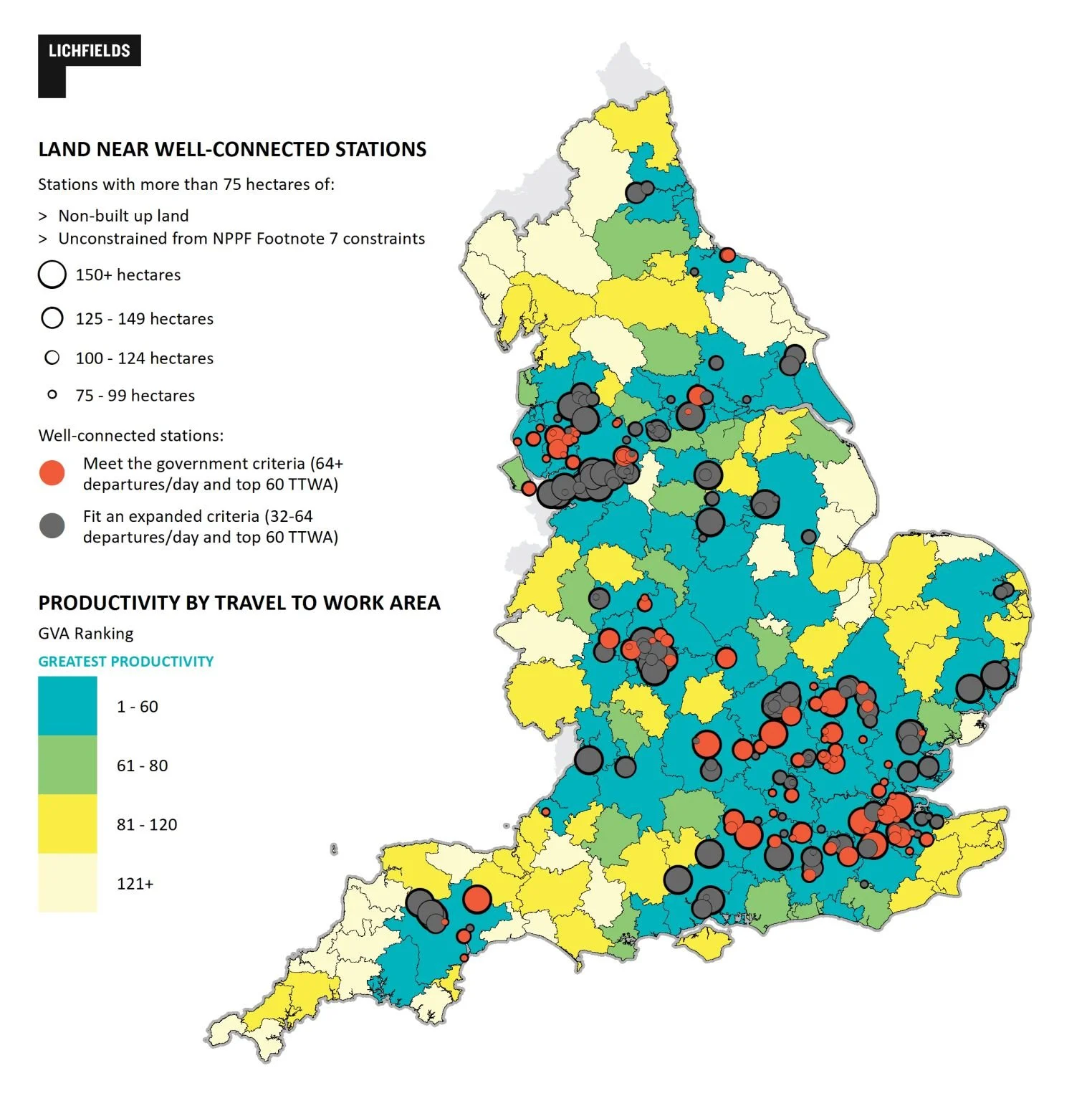
Now, it isn’t all peaches and cream. Which areas, you may be wondering, miss the cut? Loads:
Doncaster. Cheltenham. Bath. Durham. Colchester. Swansea. Plymouth. Canterbury. Worcester. Chesterfield. Kettering. Harrogate. Some very, very sustainable places. Any logic you can see in not applying the same proactive policy around major, sustainable stations like those ones? Mmmmmmmm. I’m struggling.
Lichfields’ best guess is that this policy as currently drafted could release 21,100 hectares of land to accommodate 630,000 homes. But - they estimate - if the criteria changes to stations with at least one service an hour (and potentially capable of seeing an increased service if demand increased) and in the top 60 TTWAs, the opportunity more than doubles to 1,314,000 homes. If the policy criterion was widened to the top 80 TTWAs by productivity, the policy could deliver 1.5 million homes.
Now, look: the train policy is a fantastic idea supported by reams of research over many years from all over the world. It’s a powerful direction of travel (no pun intended). It’s bold. And it will make real and immediate change all over the country. That’s what sparked the judges’ interest.
But heck, folks. We’re either in an emergency or we aren’t. So. Some gentle feedback: there’s no reason to stop at 60 TTWAs (make it 80 - at least), and add flex over allowing sites to come forward around stations where future demand could lead to 2+ trains each way per hour. Then we’re really talking.
So yes. It may need tweaking. But that’s what consultations are for. Tweaks aside, the boldness and clarity of the “big idea” behind this policy make it a winning proposition. Congratulations to all involved.
Choo. Choo.
🏆 Missed chance of the year 🏆
Nobody’s favourite award, let’s be honest. And there were several nominees. Weirdly, with its fervent anti-Doncaster bias, the now-award-winning train policy was right up there.
Still. In the end, there could only be one winner. And the judges were unanimous. The 2025 gong for the biggest missed opportunity goes to:
Making NDMPs non-statutory.
Now. This one isn’t exactly mainstream. No - it’s an award for the hardest of hardcore #planoraks. But still. Let me keep it brief:
The legal system for planning in England and Wales is, at present, “plan-led”. What does that mean? I explained it a bit here and here. In a nutshell, since 1991, the law has required planning decisions to be taken in accordance with the development plan unless material considerations (i.e. these) indicate otherwise.
Which sounds fine until you realise that things like the NPPF and the PPG are no more than “material considerations” in that exercise. How much weight those things get vs., for instance, development plan policies depend on the exercise of evaluative judgment and discretion by individual decision-makers. Which, when you think about it, is really weird.
It’s weird because the planning system is the Secretary of State’s machine. He runs it. He can change it. The NPPF sets out his vision of what it’s for and what it’s trying to achieve. So the NPPF should, you’d have thought, be paramount when taking planning decisions. And often, in real life, it is. But not necessarily. And not under the law. Under the law, as I say, the NPPF is just another material consideration. And the weight it gets is up for grabs. If, for instance, a local plan policy conflict with what’s in the NPPF, then resolving that conflict is a question of judgment. On which different decision-makers may disagree.
Why might NDMPs be a good thing? They could speed up and streamline plan-making by removing duplication. They could speed up decision-taking by providing a clear and consistent framework development management. But for my money, they can really only do these things if the law changes.
The previous Government’s Levelling Up and Regeneration Act 2023 enacted some major changes to this set-up at section 93. I talked about them here. Those provisions are on the statute books, but have not yet been brought into force. If they were, the legal position would change in a dramatic way. Long and the short of it: national policy expressed through NDMPs would be put onto an express statutory footing. You would have to determine planning applications in accordance with NDMPs as well as the development plan. And any conflict between them and the development plan is resolved in favour of the NDMP.
That would, at a stroke, solve the riddle. Our planning system would be normalised. It would be put onto a logical footing. There would be no purpose in local plan-makers attempting to circumvent NDMPs. The law would make their attempts totally futile.
Why would this be a good thing? In a word: certainty. Again, the current system is a fudge. Because albeit the NPPF is the apex planning document in our system, under the current statutory framework it has - in a sense - a “lesser” status than local development plans which are, in some cases, decades out of date. That position is counter-intuitive. It’s illogical. It’s basically impossible to defend from first principles. And, to be fair, this Government isn’t really trying to defend it from first principles - the argument in its “case for non-statutory policy” at p.10 of the consultation document is that NDMPs can get by without statutory force. But getting by shouldn’t be good enough.
For NDMPs to work, and to work fast by immediately superseding policies in adopted plans, and to make absolutely clear to plan-makers that drafting their own takes on bespoke local policy is a waste of tame, and to make sure the NDMPs have immediate, decisive heft in decision-making: for all of those things, s.93 LURA sets out the hierarchy clearly, and regularises our planning system at the same time.
Without s.93, doing our NDMPs on a “non-statutory” basis, we keep… the fudge. The perpetuation of a decades-long fudge. The uncertain situation where e.g. multiple DM policies will now have to be considered (some in adopted policies, some in new NDMPs, some in neighbourhood plans) which cover the same issues but in different ways, and resolving which to use, giving weight to the different options, and synthesising any tensions between them all would all be a matter of subjective judgment on a case-by-case basis. Which - sorry to be that guy but… - risks chaos.
Same goes for plan-making. Whether particular “bespoke” approaches to decision-making policies are justified in particular areas will be up for grabs at plan examinations, wasting time and public money debating exactly the thing that NDMPs were designed to avoid.
In the end, not making NDMPs statutory - aka (in law anyhow) keeping everything just the same as it is already (because obviously it’s all been going so well) - is a huge missed opportunity. It will slow down plan-making (because despite what’s in the new NPPF, authorities will still chance their arm at bespoke approaches to development management). It will slow down decision-taking (because, as above, arguments will now rain down on how conflicts between NDMPs and development plans are to be weighed in the endless planning balance). It will make the lives of planning inspectors, planning officers and planning committee members harder. It will diminish the power, speed and efficiency that NDMPs were supposed to achieve in the first place. It leads to system which cannot be defended.
And the worst bit: we already have the legislative apparatus to sort it all out. Gove did that. So we wouldn’t even need a new law. Ah. Shame.
A glimmer of light is that the Minister and the consultation document itself have confirmed the book may not be entirely shut on this debate, so… we’ll see how it goes in 2026. It’ll be awards-season again before you know it.
In the meantime, #planoraks, I hope you have happy and healthy festive breaks. Read the NPPF, sure. But not too hard. Not yet. It’ll still be there when you get back. When the dust settles, when we all get to re-read it properly, re-check our train timetables, and work out exactly what all of this is going to mean. And then, we can start sharpening those consultation pencils. And get writing.
But that’s a 2026 problem. For now, stay well. Relax. Enjoy yourselves. Merry Christmas, happy Chanukah, or indeed whatever you happen to be celebrating this month. And I’ll see you on the other side. In 2026. When #planoraks will do what they always seem to do. Come rain or shine. Or leaves on the line. Which is to find a way together, somehow, to hunker down through all the chaos, and to #keeponplanning.