
Why NPPFs fail #1 - planning by committee

They call it “planning”. Well. They should probably call it “waiting” instead.
Because that’s what we’re doing, folks. This is a service industry, and we’re all waiters now. We’ve spent the first half of this year, as normal, waiting - on the perpetual cusp of another new national planning policy framework (more of which here - due - so the Minister tells us - in the Summer, i.e. [so we hope!] before Parliament rises on 16th July 2026).
And as we wait, we speculate. On what may change. On what could work. On what won’t.
But I wonder - while we pass the time between consultation and policy - can we ask a different question? A harder question: what has worked?
It’s a fair question, isn’t it? I mean, we’ve had 14 years of NPPFs now of different stripes. Some good. Some bad. They’ve pushed and pulled us in different directions. But has anyone thought to check which bits have actually helped and which bits haven’t?
On a rainy April day in 2023, then-Housing Minister Rachel Maclean, just a few weeks into her new gig, was asked that question by the select Committee: has there had been an impact assessment conducted on any of the NPPF changes made since the NPPF was first introduced in 2012?
What did she say? She said what I suppose most of us would’ve said. She blagged it, and said she was “sure there will have been”. Fair assumption, right? Wrong.
The Government has not published any assessments of whether any of the NPPFs have actually worked. Nothing. Nada. Zip. Niente.
The closest thing we get to that analysis has come not from the Government but from the Office for Budget Responsibility. But the OBR looks forwards, not backwards – it makes assertions about the impacts new policies may have, without evaluating the impacts current policies have already had. Its forecasts are not based on any econometric, empirical or “bottom up” quantitative analysis or modelling. They are just “judgments” – a professional finger in the air – and those judgments are caveated, cagey, and unevidenced.
It’s easy to say the planning is “broken”. That’s a game anyone can play. But if we want to get on with fixing it, try flipping the question around: how could we tell if a planning system is “working”? What would that look like? That would be worth knowing. Because if we could tell what works, well… we could decide to do more of that, do less of the other stuff, and we’re in business. That might even help us with the unenviable task of finalising this long-awaited new NPPF.
How about this as a starter for 10: a national planning policy “works” if it causes or contributes to improvements in plan-making and decision-taking that are consistent with achieving the Government’s objectives for the planning system. Consider e.g. 2 of those objectives which have been consistent in national policy since 2012:
(i) “Significantly boosting” housing land supply – a “radical change” in policy in 2012 that has been an aim of every version of the NPPF since, including the latest one; and
(ii) Increasing local plan coverage.
After 7 [NB soon to be 8] versions of the NPPF, what does the data tell us on whether and how national policy is helping us do either of those things?
It’s not an easy question to answer. We can’t focus simply on overall delivery – numbers which can be inflated and depressed by a range of wider macro-economic issues and policy initiatives that have nothing to do with planning (e.g. Help to Buy), as well as the constraints in the wider planning system like the ones James Maurici KC talked about here.
To come closer to isolating the impacts of national planning policy, we could consider the extent to which rates of (i) approval for planning applications/appeals, and (ii) adoption of local plans have responded as those policies have changed as the NPPFs have come and gone:
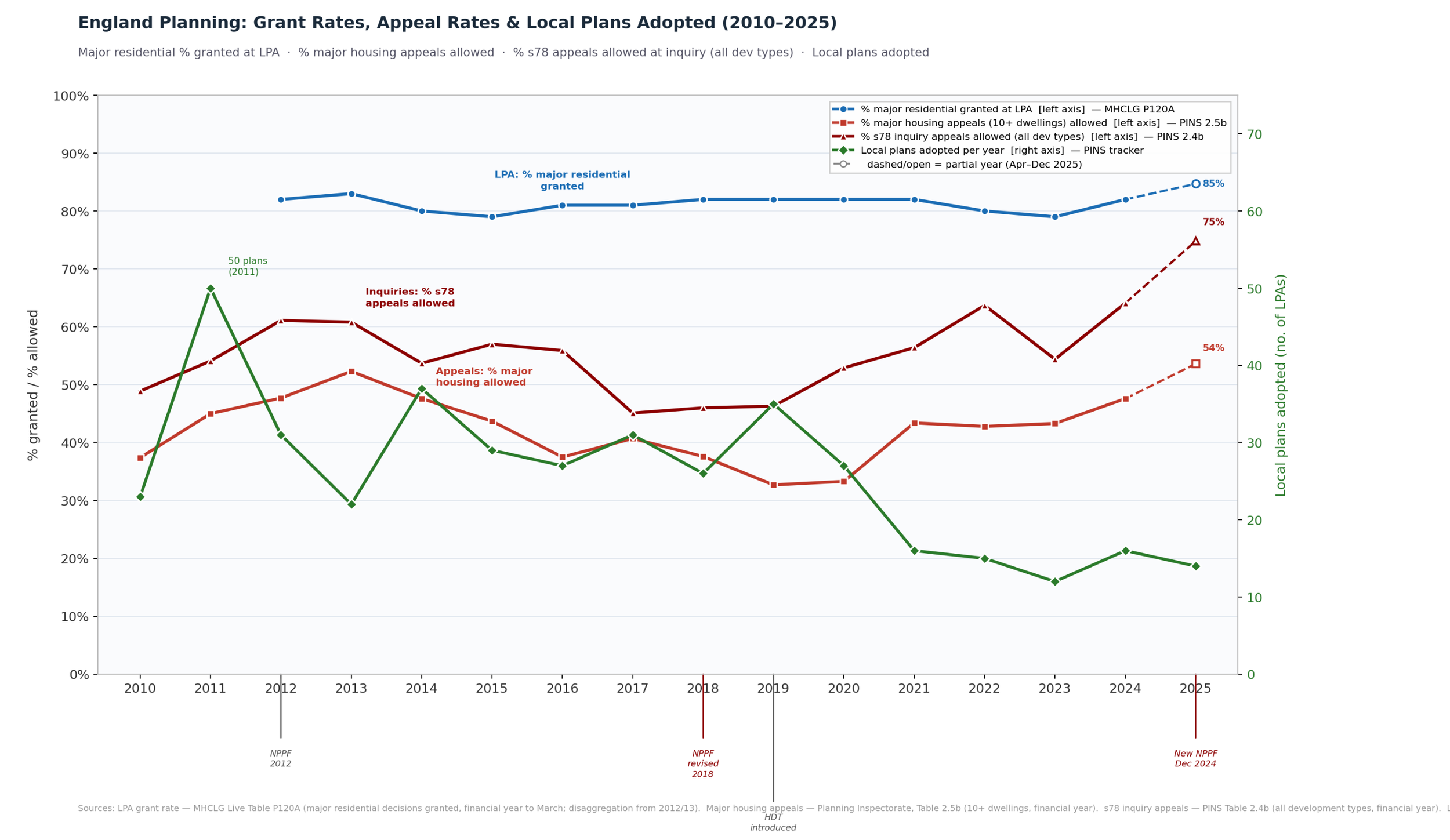
What do we see? We see that:
(i) “Significantly boosting” housing land supply – for major housing schemes determined at the local level, 14 years of new NPPFs have made almost literally no difference at all to the overall % approval rate - up or down. Obviously there are cases at the margins, but overall… local authority decision-making has basically been immune to the effects of changes in national policy.
(ii) What’s worse, if anything, new NPPFs have the effect of depressing new plan making (which of course itself has the effect of depressing housing delivery).
So. Here’s an inconvenient truth for you:
As far as we can tell, national planning policy…. generally speaking… does not work.
The much blogged-about sequence of NPPFs since 2012 has either made no difference or worse (in several cases) has been antithetical to achieving the Government’s objectives for the planning system. Of course, there are many (mega and important) cases on the margins, and the position is totally different if we’re talking about the small % of cases managed by planning inspectors where national policy matters a lot, but at the macro strategic level: local planning authorities are approving about the same % of applications as before. Local plan numbers are continuing to crater.
Why?
Why isn’t national policy shifting the dial in the way that successive governments want it to? What’s gone wrong? What would we have to do to change things?
There are, as I suspect you already know, loads of reasons. I’m going to be giving my best shot at answering this question comprehensively at this Autumn’s JPLC Oxford Planning conference so please do come along to discuss this if you can. The reasons are legal (here’s looking at you, section 93 of the Levelling Up and Regeneration Act 2023). They are political (enter stage left the Gove-ian era resistance to green belt reviews, or Eric Pickle’s kiboshing of on-shore wind power). Sometimes, it’s just loose drafting (see the need for the Supreme Court to resolve a raft of inconsistent High Court authorities over several years on the meaning of the word “for”). The list of reasons is long - so many more blog posts to come. Happy days.
So to get this ball rolling, I want to start with one of the reasons national planning policy keeps failing. Just one. But it’s a big one. Let’s start… local. Here we go:
Planning is difficult. It’s complicated. It’s (over-)technical. Law. Policy. Science. Engineering. Statistics. Design. Economics. Architecture. And on and on and on. Such a wide raft of specialisms weave together into the vast tapestry of plan-making and planning decisions. Now. In most areas of our lives, we’d want (wouldn’t we?) big decisions on matters of public interest that affect all of us to be taken by people who really know what they’re doing (although I know this point of view has been controversial in the past).
So… what about national planning policy? From the very start, its interpretation and application have fallen, for most major schemes and at least in the first instance, to non-expert locally elected politicians. Politicians like this one:
Or this one:
That’s not to deny, of course, that there are many knowledgeable, careful and diligent members of planning committees. I just didn’t have videos to share of any of them. And this is not a cheap point about the bad behaviour of particularly ill-informed and offensive politicians. It really isn’t. The problem isn’t individual (odious though some individuals may be). The problem is structural. And it didn’t have to be this way.
There’s no constitutional or democratic requirement for planning decisions to be put into the hands of local authorities. On the contrary, the planning system was informed, from the start, by a skepticism of local decision-making, its fragmentation and its baked-in lack of expertise. There were - the minister explained to the House of Commons on a snowy day in January 1947 when introducing the modern planning system - far too many local authorities (1947 Act culled the number of authorities by 90% - from 1,441 to 145), and those authorities were not acting in the wider public interest:
“Planning authorities have naturally regarded themselves as having a duty only to their own ratepayers, and in their planning operations have an eye on their own finances and the trade of their district, regardless of the interests of people outside their area.”
The minister was getting at a structural problem. A misalignment. It is a misalignment that was wodged right into the heart our planning system in 1947 and has stayed there ever since. It’s one that is played out every day in committee rooms all over the country. It keeps planning barristers in business. It’s a misalignment between:
(a) the benefits of meeting a need (often disparate, strategic, regional or even national)
vs.
(b) the impacts of meeting that need (experienced locally, and sometimes hyper-locally).
The needs the planning system is seeking to address may be regional, or national (e.g. a need for more renewable energy, a need for a railway, a need for 1.5 million homes). But the impacts of meeting those needs are experienced most of all, and sometimes exclusively, by people local to a development. The house with a turbine at the bottom of its garden. The neighbours of a field being developed for new homes. Of course, there’s one thing that all the young families desperate to move into said houmes have in common - they don’t live there yet. So the structural incentives favour objection on behalf of the constituents who already live, not support on behalf of those who don’t - time after time after time.
Take e.g. new towns (I mean, you could take anything really, but new towns work):
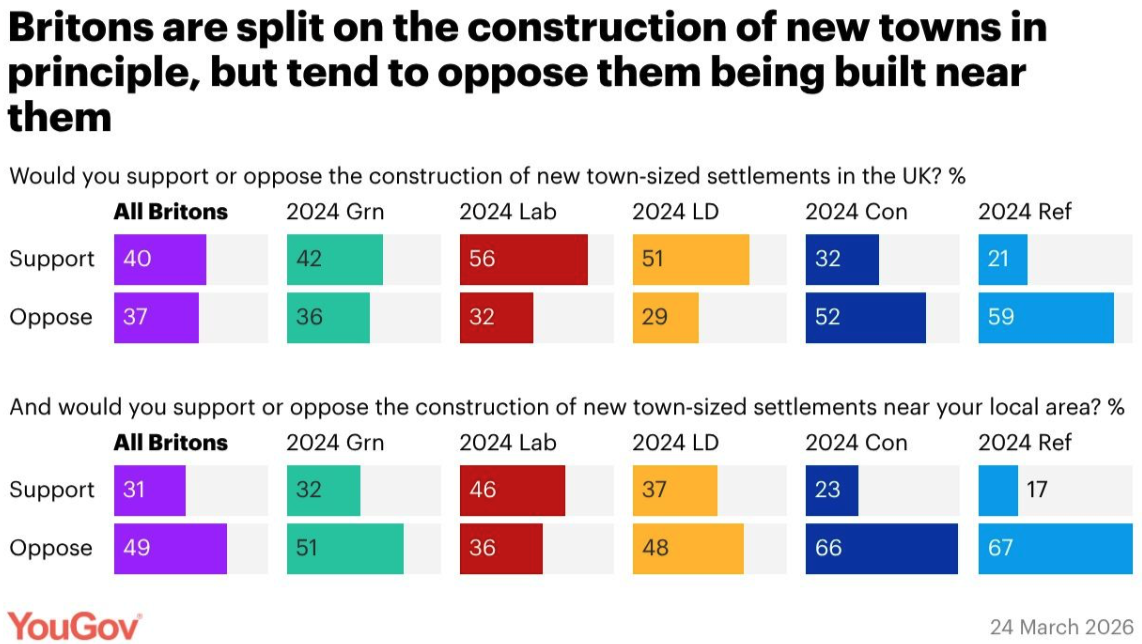
In general, more of us want them. In particular, i.e. when we’re talking nearby to where we actually live, most of us don’t want them. This is so obvious and pervasive that it almost goes without saying. It’s almost a national trait. We want new things (homes, wind turbines, cancer wards, you name it). But we want them……. somewhere else. But why is this so? It is the structural misalignment problem: needs are general, impacts are local.
The misalignment problem is so acute (and our planning system so filled with all this ignorance, drama and shouting) because our predecessors in the mid-1940s chose to give the primary decision-making powers to some of the most local decision-making bodies. In our world, the primary responsibility for making sure that these regional and national needs are being met through our planning system falls into the hands of local politicians with local incentives, i.e. to avoid unpopular impacts falling onto their local constituents with the power to vote them out.
We can tell that this structural misalignment is a problem because unlike the overall % approval rates for major housing schemes decided by local authorities which – as above – have been broadly constant since 2010, % approval rates by inspectors on appeal are highly responsive to changes in national policy (see e.g. the almost 30% bump in inquiry approval rates between 2018 and 2025). And because in other regimes that are inspector-led, e.g. NSIPs under the 2008 Act, the rates of approval are consistently very high.
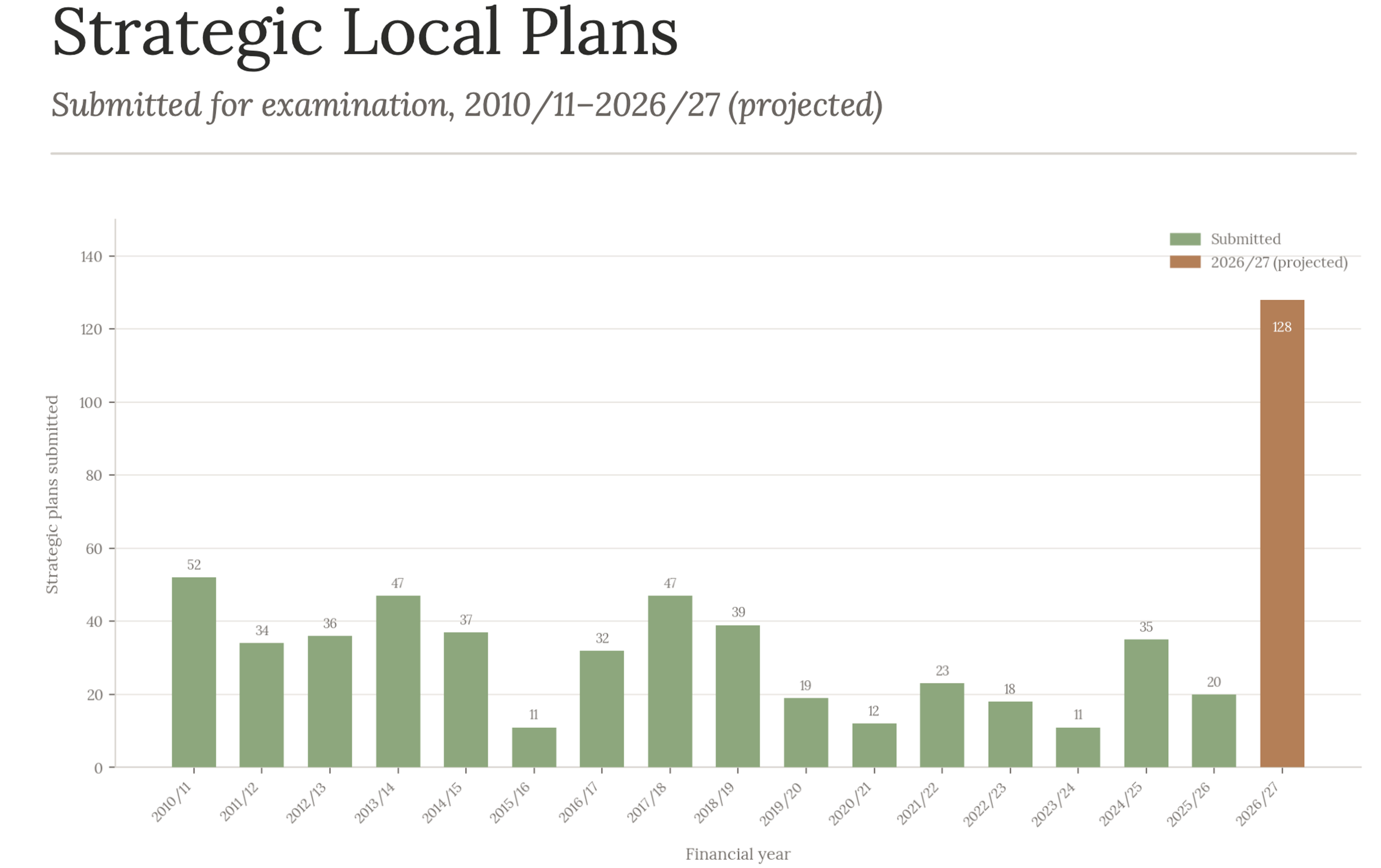
We also see this misalignment problem in the rushes to submit local plans before new NPPFs are adopted (e.g. in 2011/12) in order to avoid the consequences of national policy. That trend is continuing now:
But the biggest reason we know that this structural misalignment is such a problem is that we can see it in all of the many, many ways the Government is trying (in vain so far) to solve it. Just look at the rag-bag of planning and local government reforms in the last 12 months. What binds it all together? Where’s the golden thread that ties up e.g.:
Local government reform to refocus plan-making and decision-taking into the mayors and authorities with a more strategic geography;
The new regime including spatial development strategies (which will yank the responsibility for setting requirements for e.g. housing and employment development away from local authorities) and “NDMPs” (which will do the same for development management policies);
Call-in consultations for schemes over 150 homes;
More proactive interventions in local plan-making (e.g. here).
Ditching support for more neighbourhood planning.
What do these things have in common? They share a particular kind of urge - the urge to centralise. To centralise functions of policy-making and decision-taking. Put another way, it’s a centripetal impulse to limit the ability of locally elected members of local planning authorities to influence planning functions, and to move those functions further up the chain — either to central government or, at least, to more strategic authorities with a more widespread geography.
What is interesting about that urge to centralise is that it’s pervasive in the steps the Government is taking, but it is not being said out loud. This is centralisation by a thousand cuts - a patchwork of interventions, directions, and procedural changes. And, in a cute bit of doublespeak, even as the Government proposes to take more powers away from elected members, it claims that e.g.:
“Planning committees play a critical role in maintaining public trust and ensuring local democratic oversight within the English planning system. Planning committees remain central to transparent, consistent, and high-quality decision‑making.”
To which we might reply…
(i) Prove it! But also…
(ii) How is the Government’s idea (even if it could be proved) consistent with doing so very much to limit the role of these local committees in the planning system?
It is not a comfortable truth. But planners work with evidence. And sometimes the evidence isn’t comfortable. Plus, if we really want to understand why national policy isn’t working better, we might need to start with some difficult truths. So. Let’s start.
What the evidence suggests is that, so long as (a) our planning system is “local-plan led” - more on that here and in future posts, and so long as (b) LPAs remain the decision-makers for e.g. 90% of homes permitted in England, changes to national policy are likely to have only marginal impact.
What would a government do that really wanted to change things? That really wanted national policy to do its job? Wanted it to… work? Well, that’d be telling 😊. Tune in next time.
Enjoy the glorious city of Leeds this week for those of you who celebrate (don’t forget the lanyards or the gilets), and for all the others - stay well out there #planoraks. Keep your heads down. Summer just around the corner. The NPPF can’t be too much longer now. Surely? Can it? And in the meantime, for all that considerable noise, do your level best to #keeponplanning.