

Last time, I said that “they call it “planning”. Well. They should probably call it “waiting” instead.” And for any of you who’d been hoping for a new National Planning Policy Framework, building on this stuff, to take pool-side on your summer hols… sorry pals. No dice. Partly because of #Burnham-gate, publication has shifted from “before the summer recess” to that most depressing of Government death-knells:
In. Due. Course.
Urgh. The worst. In due course. My best guess is now Christmas Eve [ButChristmas Eve of what year? Ed.].
In the meantime, there are (thank heavens) a great many things to pore over. For a fulsome run-down of the latest, Nicola Gooch is (as normal) the place to go: here.
Prime amongst the week’s big news: a draft new London Plan is here. And much in it to discuss in future posts: tiered affordable housing thresholds, industrial land released for homes, a place in the sun for AI and life sciences, and finally some proposals for (whisper it quietly) green belt release in London.
But not today. Today, I want to talk to you about one thing. A big thing. A (huge) number. But before we get to the number…
How do we work out how many homes we need?
Before 2010, the answer was regional strategies. But in 2010, then-Secretary of State Eric Pickles decided to wipe away regional strategies because:
“Top-down targets from regional quangos and bureaucrats” aka “failed Soviet tractor style top-down planning targets” were a “terrible, expensive, time-consuming way to impose house building and worst of all threatened the destruction of the green belt”
All of which amounted to “a national disaster that robbed local people of their democratic voice, alienating them and entrenching opposition against new development”.
Then-”Decentralisation Minster” Greg Clark (now back in town as our Secretary of State at DHLUC) added “regional edicts, which allowed communities no say, injected poison into the planning system which stymied development.”
From 2010, each planning authority was set the task of working out its own housing needs, its so-called “full objectively assessed need” (numbers which were, famously, not full, not objective, not assessed and had nothing to do with need).
It was a… disaster. It became the greatest single cause of delay to plans being made. And the greatest challenge to their adoption.
Scroll forward to 2018, when notorious Communist, Theresa May, introduced a policy on “local housing need” (LHN) through the 2018 NPPF. A standard formula to calculate local housing need for each planning authority. It’s an idea which evolved from the 2016 Local Plans Expert Group report here. Its central purpose: to make local plan-making easier.
Are authorities required to plan to meet that LHN number? Stalin-style?
Nope.
Meeting the number isn’t mandatory. The formula gives authorities a starting point to work out how many homes they need, but not an end point. That is because it doesn’t account for policies e.g. growth strategies, or constraints to new development, like the Green Belt, National Parks or Areas of Outstanding Natural Beauty where new building is restricted. So authorities can – and regularly do – plan to under-shoot their need figure by hundreds or thousands of homes.
The approach to LHN has been retained but updated, and the formula tweaked, by the Labour Government through the 2024 NPPF.
The LHN numbers are invariably criticised. From all sides. Too high. Too low. Never just right - remember the “mutant algorithm” wars? And sure, we can always quibble about the detail of how formulas work. But in the end, the local housing need policy is designed to allow us to plan to put more houses where they are needed. Where people will be. Where households are going to be formed. It’s easy to criticise statistics. Numbers can’t fight back. But behind all of those numbers are people. Young, old, and everywhere in between. People at every stage of life - united by one thing. They need a home. And they’re relying on our flailing system to provide one for them.
Faced with all of that responsibility, it has always seemed to me that the very least the planning system can do is to acknowledge these people. To recognise them. To give their needs some weight. And it may all seem horribly technocratic, but that job… that all-important task… it begins with a number.
Now, what does all of this have to do with London? A great deal, because…
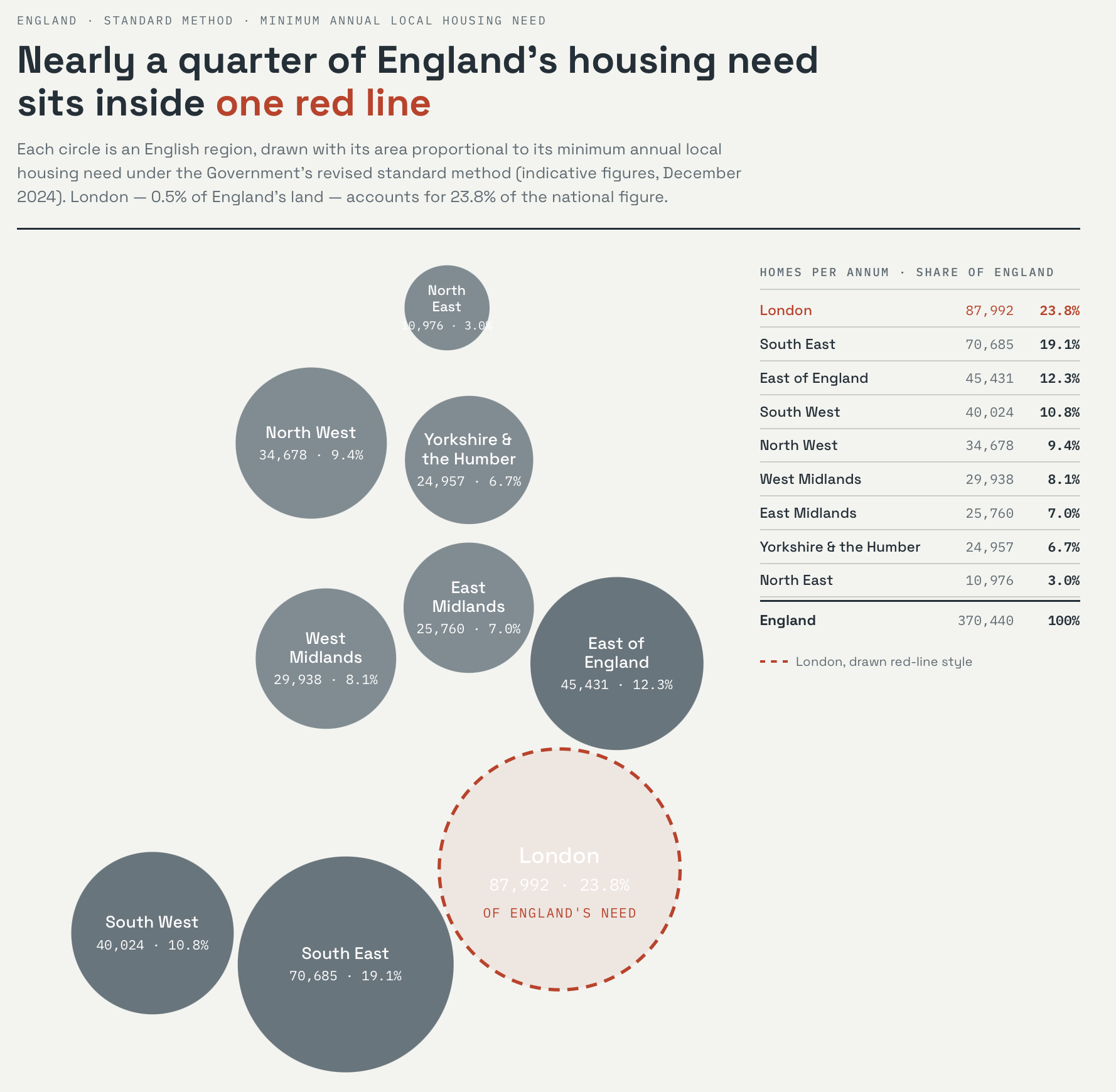
Almost 1 in 4 of the new planning permissions for housing this Government targets through LHN are supposed to come forward in London - that’s 87,992 every year out of the 370,408 annual total. The Government's stated ask of the capital derived from that target is 85,000 homes a year — 850,000 over the decade to 2036. That's the capital's slice of the national need figure of national picture which underpins the Government's totemic target of 1.5 million homes this Parliament.
So. The position is stark: unless London hits its targets, we’ve no shred of a hope of getting remotely close to the overall national target. Full stop.
So. Will London hit its target? 85,000 homes a year. Doable? Well, no. Not at any point since before the 2nd world war:
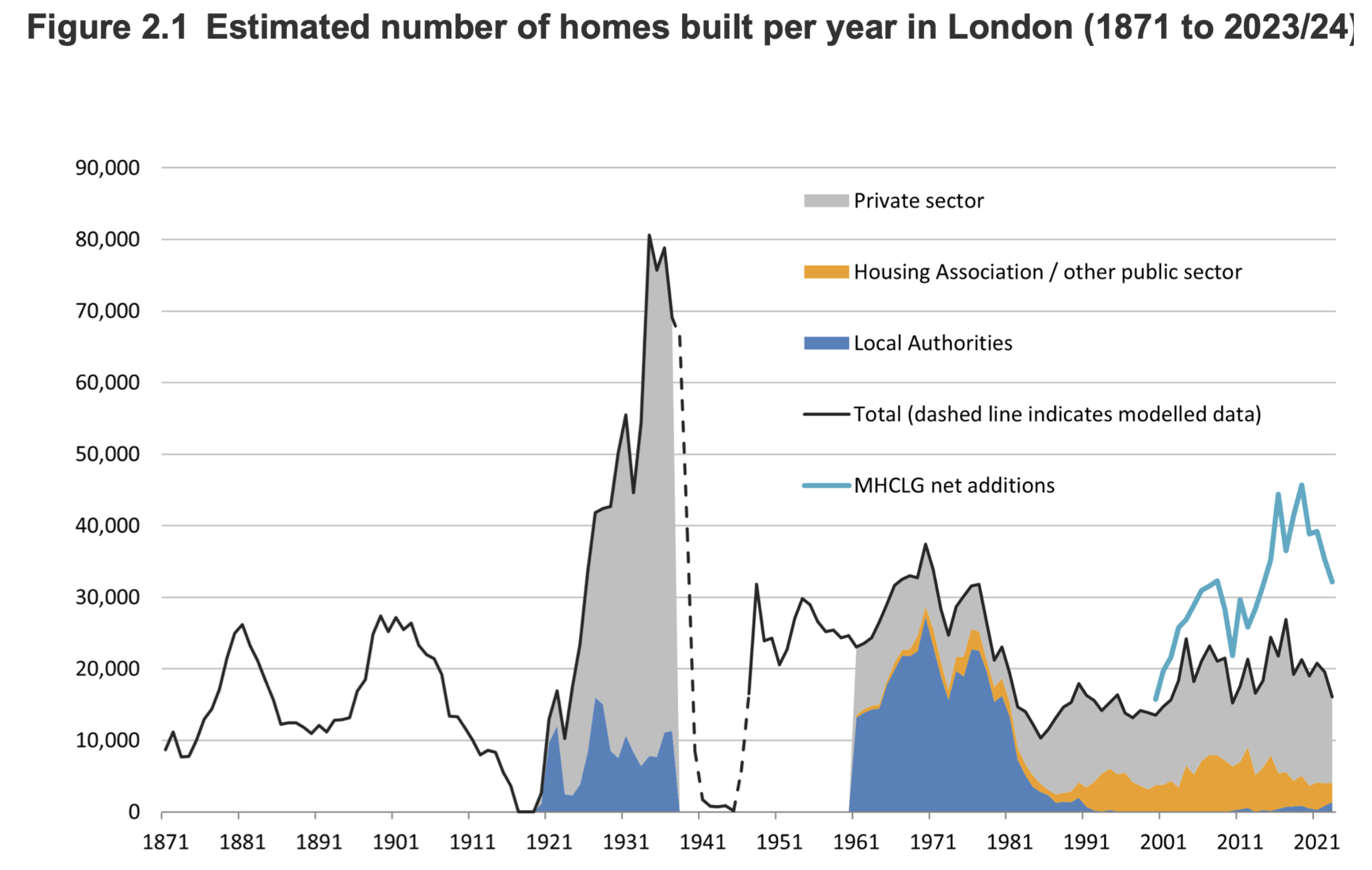
And the direction of travel? Naaat good. In the year to September 2025, housing starts fell in London by 30% — the only region in England where they did.
The current London Plan was adopted in 2021. It targets 52k homes a year spread across all 35 of London’s Boroughs. Well below LHN. And, as the chart above shows you, even that target isn’t being met. Not by a long shot. So… there’s a huge amount of work to do in London. On unlocking designated Opportunity Areas, on funding for transport improvements, on funding affordable housing properly, and making schemes viable in a world of soaring construction costs.
So, what’s the GLA planning for next?
The draft London Plan proposes 558,000 homes between 2028 and 2037. Around 55,800 a year.
A figure the Plan describes as what could "feasibly deliverable in the coming decade, taking into account viability and build-out rates". The Deputy Mayor for Planning, Jules Pipe, calls it more "credible" than the Government's number - while accepting that even this target isn't deliverable as things stand. 😬 It’s a stretch target. Again, London's recent delivery is in the low-to-mid 30-thousands a year, its best recent average around 37,000, and the trend is downward. Which means the new Plan's 55,800 a year isn't timid. It's roughly 50% above the average the capital has actually achieved this decade. And the Government's 85,000? More than double it. Double. Every year. For a decade.
Now. You don't need to be Carol Vorderman to work this one out. But just so we’re on the same page:
850,000 minus 558,000 = around 300,000 homes.
300,000 homes. That national government says are needed. That the Mayor’s own evidence base says are needed too. In and around the nation’s capital. Over the next 10 years. 300,000 homes that we are deciding not to plan for.
Does everyone (the Mayor of London, the Government) accept a need exists for those 300,000 homes? Yep.
Is there some other way we’re proposing of covering the need for those lost 300,000 homes elsewhere? Nope.
So. That’s that. Remember all that talk about “mandatory” housing targets. Well. Not so much.
So, what to make of all of this? Here’s a few quick-hit thoughts:
Constraints-based vs. needs-based planning. This plan doesn't aim to meet need. It starts from an assessment of what's "feasibly deliverable" - viability, capacity, market absorption - and works backwards. Sensible? Fair? Again, 558,000 homes isn't defeatism. Measured against what London has actually built, it's a stretch. The Deputy Mayor's "credible" number would require the capital to beat its best-ever sustained rate by around half, every single year, for ten years. When even the "unambitious" figure is heroic, something's else is going wrong.
Does the standard method simply "not apply" in London? It certainly does. It’s the yardstick against which a 300,000-home gap will have to be evidenced, explained and justified, in public, line by line. We will see what the new Secretary of State makes of this, and it’ll be a fascinating City Hall v Marsham Street tussle. Because if London doesn’t have to come anywhere remotely close to meeting its LHN, why… other authorities might reasonably start to ask… should they?
Which means the real story here isn't the London Plan at all. If the biggest single line in the national housing ledger is, on decades of delivery evidence, overstated relative to anything achievable, then LHN as a national formula has a hole in it - at least 300,000 homes wide - that neither City Hall nor Marsham Street knows how to fill. The Mayor didn't create that gap. He has just committed it to paper. But what it exposes is that LHN as a thing, as a formula, as a mutant algorithm, as a policy mechanism, as a structure… its broken. Dead. Caput. Toothless. And here’s the worst thing: everybody knows it. But nobody is proposing to change it.
And then there's the 1.5 million. Remember (how could you forget) the manifesto commitment: 1.5 million homes over this Parliament. The obstacles have been piling up for a while - plan-making delays, viability, build costs, capacity in the industry, take your pick. But this one's different. This is the Government's own strategic planning flagship - the model, we were told, for spatial development strategies everywhere - declining, in terms, to plan for the Government's number. And note the dates: this Plan isn't due for adoption until 2028, with a target period running to 2037. The Parliament against which those 1.5 million homes are counted ends in 2029. So the capital's contribution to the flagship target will be governed, for almost the entire period, by the 2021 Plan and its own baked-in shortfalls.
In the end, we need to be honest. No point in fantasy numbers. Why promise 88k homes a year if they can’t be delivered, right? Particularly when we all know about how soaring costs and project viability is making building in London an epochal challenge.
But here's the thing. The standard method number was never a prediction. It's an expression of need - of the households, the families, the key workers, children in temporary accommodation, you name it - hundreds of thousands of people who require somewhere to live, and who are relying on the planning system to deliver them a home. Their need hasn't gone anywhere. What this draft plan really tells us, loud and clear, is that the largest single component of England's assessed housing need, a quarter of the whole, sits in a city which has never come close to delivering it in modern times. Not under this Mayor. Not under his predecessors.
And in the end, a national target, and a policy mechanism built on an assumption which the delivery data has been quietly contradicting for decades isn't a target with an implementation problem. It’s a busted flush. And it needs to change.
So yes: we have another nail in the coffin of the 1.5 million homes. One of many. But the question it leaves behind isn't really "why won't the Mayor plan for 850,000 homes?". It's something more like this: if your flagship national target requires the capital city to double its best-ever output in modern times - and the capital's own strategic plan has just politely declined - what, exactly, is the plan now?
The consultation runs until 15 October 2026 - it’s going to be a doozy.
Enjoy the sunshine, friends. Next time we talk, there could be (who knows) a new Secretary of State. A new Housing Minister. We live in interesting times. Not a new NPPF though - that’d be asking too much. But in the meantime, whatever else you do, however many homes you’re planning for, stay well #planoraks, keep cool, and do your level best to #keeponplanning.