
#NPPF2026 - Welcome to the Future!

Sheesh. I’m telling you. Yesterday will go down as one of those “where were you when…” moments. In a summer so stuffed with drama (this awful heat, the Burnham of it all, Count Binface, staying up late for that Mexico game, thinking again about investing in some kind of air-conditioner), the moment, dear #planoraks, has finallllllly come. Our moment. A total start-again-with-a-blank-page once-in-a-generation kind of re-write for national planning policy in England. We have it. Where do we have it? We have it here:
The new NPPF: link.
The Government’s response to the consultation: here.
And - would you Adam and Eve it - the housing delivery test results too: here. Only 2 years late. But who’s counting.
So, 8 months on from that draft and just the 20,572 consultation responses later, what do we have? In all the media fracas about saving pubs, you might be forgiven for missing what has really happened this week. Which is the most powerful, coherent and quietly revolutionary national planning policy we’ve ever had. That doesn’t mean you’ll necessarily like it - in fact, the consultation responses show us that most won’t. It doesn’t mean the policy will actually work. In fact, it probably won’t work - we’ve been over that one: here. Strategic plans sound great, for instance, until you actually draft one and it turns out you’re short to the tune of 300,000 homes in the most important housing market area in England. Anyhow. Still.
Credit where it’s due, folks: this is a big swing. A comprehensive policy that deserves to be taken seriously. This is, among many other things, the kind of document that only happens with an experienced Planning Minister in post long enough to get to grips with the brief (not something we’ve been used to in the plan-i-verse for many a year).
For an initial crib sheet into the overall structure (SDS-what? NDMP-who?) see my run-down of the consultation version from last December: here. That architecture held. Twenty chapters. Plan-making policies on one side, national decision-making policies on the other. 131 coded policies.
Ground rules: this blog post is definitively not a summary of all 131 of ‘em. You’ve probably at least skimmed (and maybe a lot more that skimmed) the ones you’re particularly interested in already. I won’t paste them here again. We all have shed-loads of reading to do anyhow. Reading the summaries alone would take hours. And then, at some point, we’ll need to get round to reading the thing itself. Simon Ricketts has already shared a helpful tracked change version if you’re in the market for one, alongside his early reflections: here. Nicola Gooch is already on the case: here. If your Linkedin feed is anything like mine, you’ll have your pick of webinars and summaries galore for months to come.
Instead, what I’ll do now, on this day 1 of a brave new era for #planoraks, is give you some quick-hit reflections on what I think are the very biggest points of all. Oh there are more. So many (how do you define a veteran tree, dropping local plans to 10+ year periods, the survival of local energy efficiency standards, the continuing arm-wrestle between town-centre planing vs. Class E… urgh, no, focus, come on). But here are the big things I think lots of us will be thinking about, talking about and (sorry, but I am - in the end - a planning barrister) arguing about for years to come. You’ll have your own top 10 list. Well. Here’s mine.
The slow death of local development management policy
The national decision-making policies (“NDMPs”) in this document apply and they apply today. Right now. All 79 of them. The statutory scheme for planning has not (yet) changed - the Government’s keeping that one under review. Close readers of these pages may remember I think it should’ve changed - see here. But that’s for another year. So these NDMPs are now “material considerations” in the balance - albeit ones the government expects to be given “critical” importance.
The question for now is how what we’re all supposed to do with the forests of local plan policies all over the country which don’t fit in with this new NPPF. Which don’t reflect e.g. the new train station policy (more on that below), or the new tilted balances, or the new approach to densities, or to viability, or the “grey belt” and on and on and on.
Here’s what we do: if existing local plan policy is - in whole or part - materially inconsistent with the new NPPF, it gets “very limited weight”. Not just limited. Very limited. In the end, precisely how much weight that amounts to remains something for decision-makers to assess (which is part of the reason that it would be neater for NDMPs to be statutory). But nonetheless this is a powerful step. In a similar vein, plan-makers are told not to include policies which “duplicate, substantively restate or are inconsistent with the content of national decision-making policies”.
What’s happening here? The Government is taking back control [eesh - surely a better phrase? Ed.] of the approach to development management from the local plan-making regime. In a way that I think can be described as “radical”. Standardisation. Centralisation. It doesn’t feel very “Burnham”, does it?
Nonetheless, powerful though it may be, last December's Missed Chance of the Year is August's too. The provisions in the Levelling Up and Regeneration Act 2023 at section 93 (which I talked about here) remain on the statute books, but have not yet been brought into force. Is this new NPPF the best that can be done without the statute? Probably. Is it the fudge I described in December? For sure. Every one of those "materially inconsistent" arguments will now be had, case by case, in front of officers, committees and inspectors. It didn't have to be this way. Alas. A fudge we have. But it’s a bold fudge.
Is your local plan “up to date”? Who cares.
Remember those arguments about whether policies are “out of date”. “Baskets” of all of those “most important” policies. That stuff? Gone. All gone. The concept of “out-of-datedness” itself (which I went into a bit here), that’s gone. This is an almost entirely basket-free NPPF.
In particular, whether the presumption policies at S4 and S5 (more of which next) are triggered is not about time. Or date. Or datedness. It’s about place. And need. And also trains. It’s a lot about trains.
Those new tilted balances
All depends on where you are…
Within settlements (S4):This is the “default yes” we’ve all been hearing about from the Ministry’s PR bods. Here’s the nub of it:
Any scheme within any settlement gets approved.
Unless its benefits are substantially outweighed by adverse effects. And given the substantial weight lots of those benefits may now have to be getting (under e.g. policies like HO7 which require us to give substantial weight to unmet housing need), this sets a really punchy bar for refusing e.g. brownfield schemes within settlements of any kind.
It’s a default yes for planning applications within settlements subject to carve outs (including, critically, if e.g. there’s an NDMP which tells you to refuse planning permission). But still.
A big step. A bold step.
Outside settlements (S5):
Again, a fundamental change in approach.
The structure of S5 requires granting of permission outside settlement unless benefits would be substantially outweighed by adverse effects if your scheme falls into a list of particular categories. A bolstered “tilt” to the tilted balance. Again, equivalent to what the ministers keep calling a “default yes”.
The flip-side: if you’re outside those particular categories, you get refused permission absent exceptional circumstances where your benefits substantially outweigh your adverse effects.
So we need to know whether schemes outside settlements fall into these categories or not. What are the categories? Have a look at S5. Big ones include:
Redevelopment of PDL.
Reusing existing buildings.
Development a reasonable walking distance from well-connected rail stations - more on this in a sec. Because this is a biggie.
In circumstances where you’re meeting an “evidenced unmet need” (including, for housing schemes, cases where there is no 5 year housing land supply) and the scheme is:
“physically well related to an existing settlement (unless the nature of the development would make this inappropriate) and be of a scale which can be accommodated taking into account the existing or proposed availability of infrastructure”.
If you fall into one of these S5 categories, then the “tilt” in favour of permission is (and is intended to be) stronger than the previous tilt at §11(d)(ii).
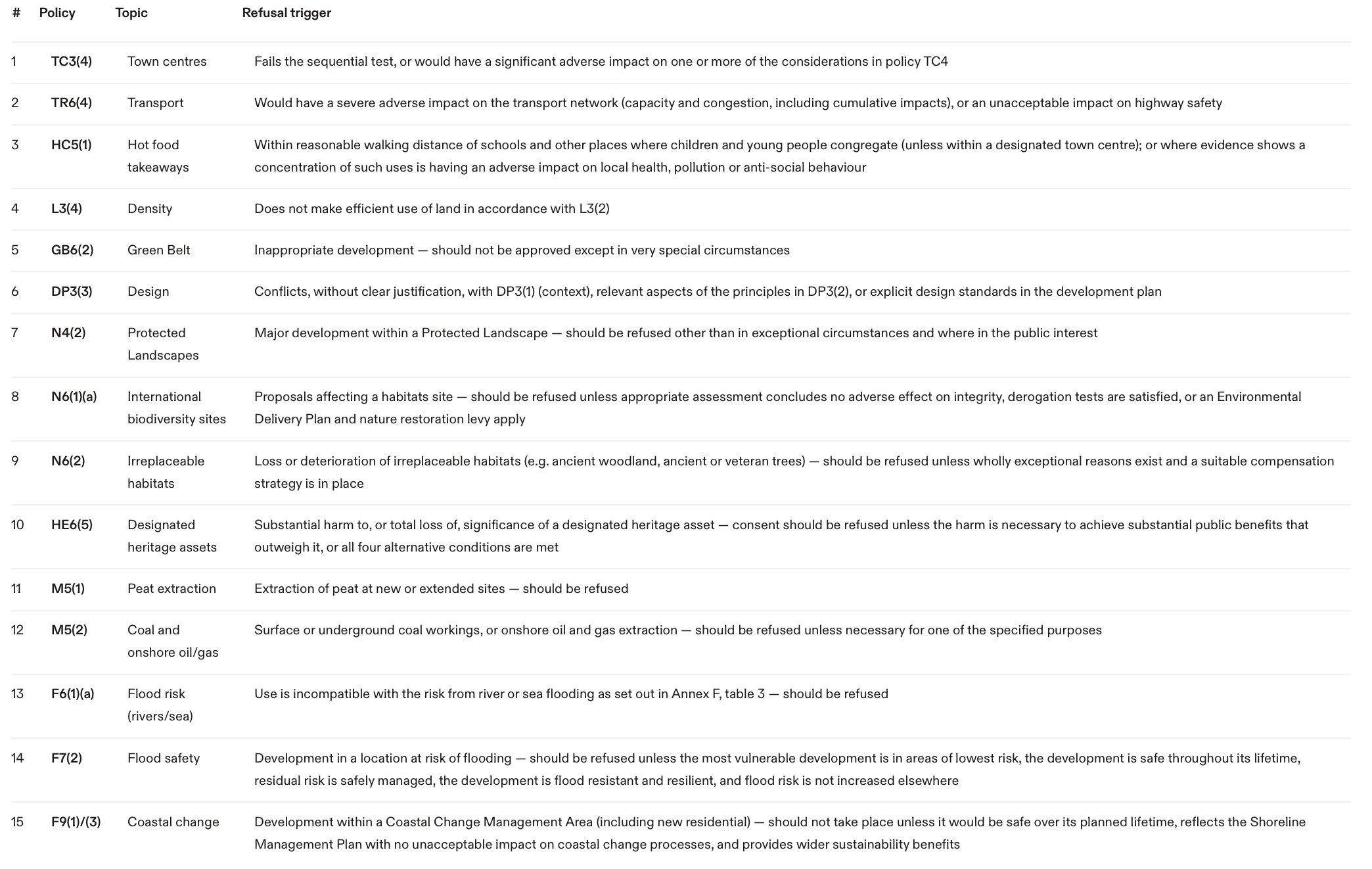
The concept of “strong reasons” to refuse permission is ditched. Instead, for decision-making, we’re told that the new tilted balance is likely to be failed if “the development proposal would fail to comply with one of the national decision-making policies which state that development proposals should be refused in specific circumstances”.
There are - I think I’ve spotted - 15 or so of those. A little crib sheet for you:
4. Tickets please!
The official #planoraks “Policy of the Year 2025” (pause for applause) is now actual policy. All aboard. Land within "reasonable walking distance" of a "well-connected station" now gets the benefit of this strong new presumption, whether it's inside a settlement (S4), outside one (S5(1)(h)) or in the Green Belt (GB7(1)(h) - where it is not inappropriate development, grey belt or not, subject to the Golden Rules. The Government didn’t blink: 52% of consultees strongly disagreed with the station policy. Well. Planning shouldn’t be a popularity contest. As I said last time, for many years, academics and think tanks galore have been arguing that liberalising our approach to planning around well-connected train stations could - at a stroke - provide land for not thousands, not tens or hundreds of thousands, but millions of new homes and businesses.
What’s changed from the consultation?
Reasonable walking distance is defined: “around 800 metres, or around 10 minutes’ walk time if topography, route availability and quality or physical barriers would prevent or discourage walking from up to 800 metres away”.
And well-connected is defined too. The draft pinned its colours to stations “in a top 60 Travel to Work Area located partially or fully within England by Gross Value Added (GVA)”. Close readers may remember that back in December I said that "there's no reason to stop at 60 TTWAs (make it 80 – at least)". Well, check this out folks: the final definition is… 80. On the button. So hello Doncaster. Good afternoon, Colchester. And Cheltenham. And Birkenhead. And Gloucester. Team Lichfields are already on the case:
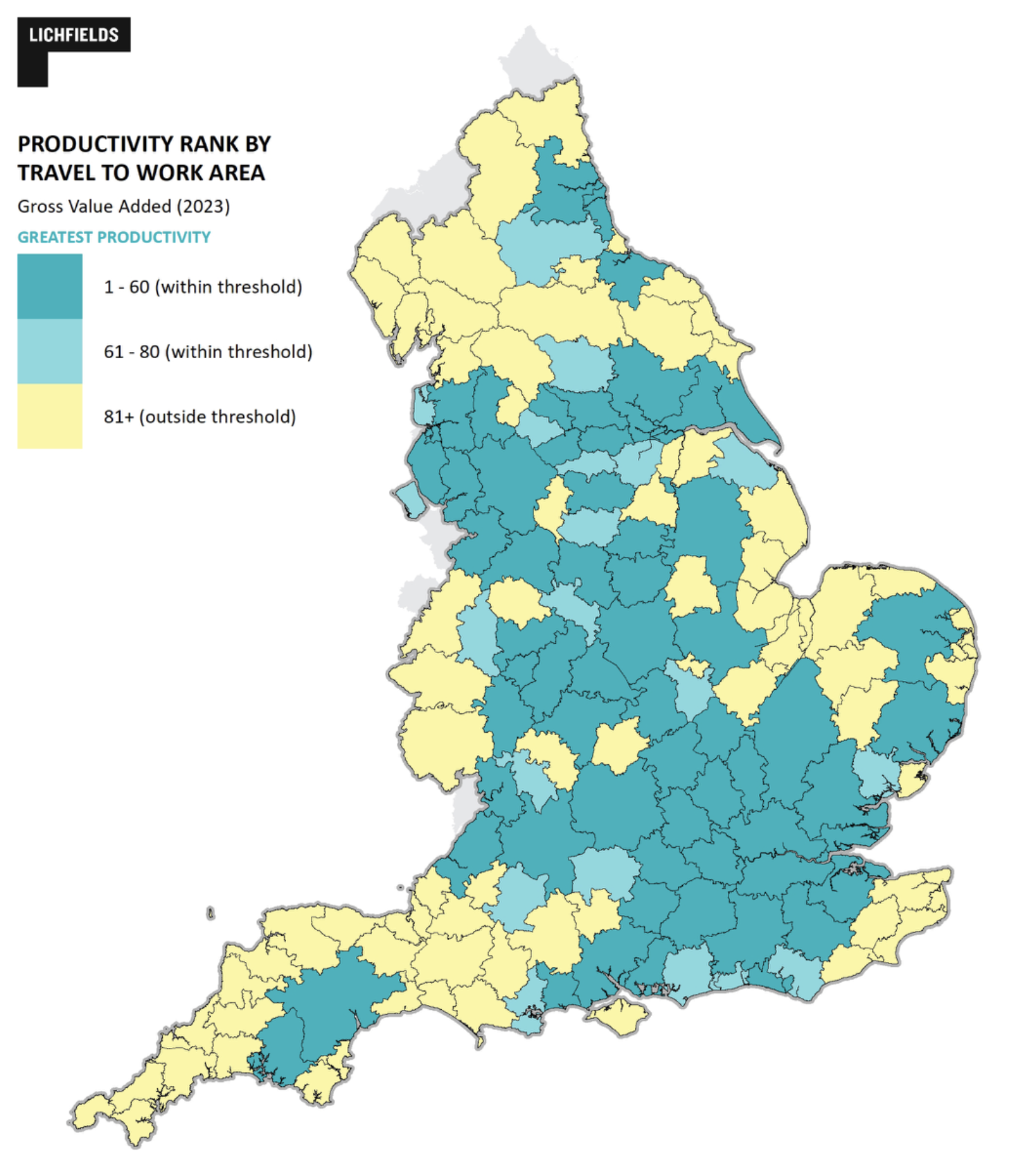
The caveat remains that your station needs to have at least four trains or trams per hour overall, or at least two trains or trams per hour in any one direction. A punchy number. Lichfield's estimate is all in all that the policy could produce consents for over half a million homes.
But if you’re going to build around train stations, you should be building efficiently? Right? Which takes us to…
5. Density
Sure it may’ve been award-winning, but the consultation draft NPPF’s version of the train station policy was doomed to fail. That’s because of the cross-over into policy L3, which would have required building around well-connected stations at 50 dwellings per hectare. Great for building around lots of our urban stations, but potentially disastrous for some of your more suburban or quasi-rural ones. The final version softens the numbers big-time, down to 35 dph - much more pragmatic (it goes up to 45 dph for stations with 8+ trains an hour). The previously proposed 40dph tier around lesser stations has now gone entirely.
All of which means that we have, in the end, a very powerful train station policy drastically enhanced in its geographical scope and substantive coverage from the draft. And it applies immediately, nation-wide, regardless of any other land designations (unless those designations end up indicating refusal in themselves). So. Toot toot.
6. Viability
Standardised inputs = dropped. The draft consulted on a new Annex that would have embedded standardised viability inputs directly in the Framework itself - profit levels, benchmark land values, treatment of alternative use value, and cross-checking methodology. But the Government decided more engagement is required, and we’re awaiting PPG.
Which leaves us with core policy (DM5) is broadly as per the draft. Policy-compliant proposals are assumed viable. Viability assessment at application stage can be justified if:
the development is materially different from any type tested at plan stage;
site characteristics are materially different from those tested;
the site is demonstrably burdened by costs not accounted for in the plan-stage assessment; and/or
site or economic circumstances have changed significantly (footnoted as meaning "a recession or similar significant economic change").
Review mechanisms are now dealt with through the plan-making process under PM12(4), which requires plans to set out the circumstances in which review mechanisms apply and to specify how and when viability will be reassessed over a scheme's lifetime.
The other big headline on viability relates to the Golden Rules associated with green/grey belt development. For certain sites, including strategic sites (now defined - we’ll come back to that) and for “development which is of a wholly different type to that considered in the viability assessment that informed the development plan”, a viability assessment demonstrating that it would not be possible for a development to comply with the Golden Rules may be submitted as part of a development proposal. This is a potentially seismic step - particularly for larger strategic sites on land that can meet the definition of grey belt but which have been held back so far on account of viability. On the flip-side, it risks putting an awful lot of pressure on the viability assessments conducted at the local-plan making stage, which is the opposite of what we’re supposed to be focussing on apparently but anyhow…
7. Grey belt
The postbags were heaviest here. 50% strongly disagreed with the draft grey belt policies. 53% strongly disagreed with the simplified grey belt definition. All of it survived. Grey belt is now land that "does not strongly contribute to any of purposes (a), (b), or (d)" — no footnote 7 detour (doesn’t really matter in the end, because those issues come back to bite you anyhow when you get to S5). Still nothing on what a "large built-up area", a "town" or a "historic town" actually means, so more fun to be had knocking heads together about that one. But in the end - long story short - grey belt policy survives broadly unchanged. No surprises. But it remains (for my money) by far the most important - really the only important - change to national green belt policy since it was introduced in 1955.
8. Housing land supply
Two big headlines.
First, outside the green belt anyhow, 5 year supply isn’t as important as it was. That’s because under the new S5 it’s only one way - just one - that unmet need can be demonstrated. There can be others e.g. it may be that an area which can show a 5 year supply does not in fact have adequate stocks of (for instance) affordable housing, or housing for older people, or whatever it might be. There are many more ways of activating this tilted balance than there were before.
Second, the old footnote 39 is DEAD. Getting into the weeds just a bit now… 5 year supply is measured against the plan requirement, or against local housing need once that requirement is more than five years old. Full stop. No velvet-glove "reviewed and found not to require updating" carve-out. So that’s the end of that.
9. Strategic sites - the biggies
I spent most of last year at what is (so far as we can tell) the largest and one of the longest call-in inquiries for a residential-led scheme that has ever come before the Secretary of State: the proposed new settlement at Highsted Park in Sittingbourne (Swale, Kent). To give you an idea: the inquiry extended over 56 sitting days and heard evidence from over 80 witnesses. The scheme includes 8,400 homes across 3 new villages (for context - that’s almost 3 times the size of the original Cambourne scheme consented by the Secretary of State in the early 1990s), along with 34 hectares of employment floorspace, 5,000+ new jobs, 350 hectares of public open space including new country parks, 5 new schools, new healthcare facilities and local centres, 2 new strategic link roads and a new motorway junction. A decision from the Secretary of State is still awaited so we shall see. But one thing that became painfully clear over that process is quite how inadequate regular work-a-day planning policy can be when it comes to handling the kind of bold, big new schemes the Government is trying to bring about.
This was the topic of James Scott’s now-famous talk at last year’s Oxford Planning Conference. If you haven’t seen the rap yet… well. I mean. Enjoy: link. There is, at last, a suite of policies threaded through the NPPF which responds to James’ call for “flexibility over prophecy”. This is the kind of approach we are going to need if the new town programme is going to have a hope at making its way through our creaking planning system.
10. Still to come?
The IOU pile is full to bursting. Count them. Statutory NDMPs: under review. Soundness guidance: in due course. SDS/local plan relationship guidance: to be published. Traveller sites PPG: in due course. Commuted sums guidance: to be developed. s.106A: a review. National model conditions: "before the end of the year". Statutory consultee reform: response "later this year". Planning fee surcharge: consultation "later this year". PiP for medium sites: "further engagement". Viability PPG: "as soon as possible". A rules-based system whose rules are, in a dozen places, still being written. In. Due. Course.
Does it do everything the Government’s press releases promised it would do? No way. Will it actually work? It’s a long shot. But still. We are talking about the most significant change in national planning policy for (at least) a generation. So. Time to get reading. There’s so much reading to be done. It’s exhausting. But you know… we love it really, don’t we? We must do. At some level. Or one thing’s for sure: this would be the wrong line of work. Please do your best to stay safe and (ideally) cool out there, #planoraks. I hope you’re well. And my goodness me through all this merry change, we’re going to need you more than ever to take a deep breath, aim your eyes firmly into the future and do your level best to #keeponplanning.